Showing posts with label mongolia. Show all posts

Wednesday, January 14, 2015

CD Review: Tri Nguyen's 'Consonnances'

Tri Nguyen
Consonnances
Lunelios

The music of Vietnam is rarely available to mainstream, world music listeners. However, Tri Nguyen's new album, Consonnances, will hopefully reignite a global passion for the traditional and classical artforms of Vietnam's musical styles and influences. Tri's latest release contains thirteen different tracks of traditional and classical-tinged folk music on the dan tranh (a Vietnamese zither with close ties to the Japanese koto, Chinese guzheng, and the Korean kayagum), as well as classical strings. The contemplative, serene, and beautifully-sweeping melodies capture a very moving and emotive side to instrumental music rarely observed in other settings. Tri's utilization of melodic tones and cheery tempos makes Consonnances shine with inner and outer beauty. The classical undertones resemble Mongolian, Chinese, Japanese, and even American theatrical soundtracks from the 1940's and 50's. At any rate, Tri Nguyen is a welcome addition to the world of music and highlights the importance of Vietnamese music necessary for any music fan of Southeast and East Asia. ~ Matthew Forss

Sunday, April 20, 2014

CD Review: Meikhaneh's 'La maison de l'ivresse'

Meikhaneh
La maison de l'ivresse
Self-Release

France's Meikhaneh produces intriguing music inspired by Central Asia, the Mediterranean, and the Middle East. The group incorporates a little Central Asian throat-singing on "Jaran tsagaan aduu." Maria Laurent's sweet vocals and her stately morin khuur (horse-head fiddle) combines to form a unique blend of vocal and instrumental music. Maria is joined by Johanni Curtet on guitar, dombra, various chants, as well as Milad Pasta on tombak, daf, and udu drum. The music is more French inspired with wistful melodies and breezy vocals on "Mellekdal" and a more somber tone on "La fille qui tourne dans une piece blanche." "O leite e o pao" contains more of a flamenco or Portuguese flair. The final track, "Talyn theme," is an improvisational masterpiece with glorious instrumentation and enigmatic vocals that are sweet, sincere, and traditional. Meikhaneh is a group based in France, but their repertoire originates from other world regions. At any rate, Meikhaneh knows how to make an album that is entertaining, memorable, and highly-recommended. ~ Matthew Forss


Thursday, December 13, 2012

CD Review: Urna's 'Portrait: The Magical Voice From Mongolia'

Urna
Portrait: The Magical Voice of Mongolia
Network

Urna is an Inner Asian songstress from the great, vast expanse of Mongolia. With ties to China and Western Europe, Urna employs a range of instrumentation that represents Inner Asian genres. The violin, zither, sheng, cello, zarb, udo, viola, accordion, morin huur, sax, guitar, and assorted percussion make up the instrumental repertoire on many of the songs. The spacious acoustics and free-flowing vocals are not particularly throat-singing examples. This is classic, Mongolian vocal and instrumental music that is calm, reserved, and contemplative. It is not rigid, boring, or plain. The music is similar in tone to contemporary examples coming out of Nepal and Tibet. Yungchen Lhamo is a similar comparison. At any rate, the thirteen tracks and one hour of music are a joy for fans of Inner Asian folk music. Liner notes are in German, English, and French. ~ Matthew Forss

Sunday, January 30, 2011

CD Review: Yat-Kha's Tuvan Rock on 'The Ways of Nomad'


The Ways of Nomad: The Best Of

The Tuvan rock and throat-singing of Russia's Yat-Kha has been an iconic presence in the world of Tuvan music for the past two decades. Led by vocalist and guitarist Albert Kuvezin, Yat-Kha takes the world by storm with traditional instrumentation and electro-ethnic elements that are darkly inviting. The name of the group is coined after a Central Asian instrument. The vocal style of Kuvezin has been noted as kargyraa, which is basically a deeper, more growling version of the traditional form of Tuvan throat-singing. Importantly, not all of the songs center on throat-singing. The Ways of Nomad features hits from 1995-2003. Anyone with an interest in Tuvan folk, throat-singing, Mongolian, Central Asian, or Russian folk and rock music should own everything by Yat-Kha. Liner notes in English, Russian, and Tuvan. ~ Matthew Forss

Friday, April 16, 2010

CD Review: Lian & Chirgilchin Ensembles on "The Window" (released May 2010)


Lian & Chirgilchin
The Window

The Window is what happens when two groups from different countries come together and make music for one afternoon in Los Angeles, USA. The Persian/Sufi Lian Ensemble incorporate Persian lyrics and traditional instrumentation, including the tar, kamancheh, udu and frame drum. Imagine the sounds of the ancient, Persian courts mixed with the throat-singing elements of Tuva's Chirgilchin. Chirgilchin consists of four members playing traditional fiddles and lutes, including the igil, doshpoulour, and byzaanchy. Their notable throat-singing is an excellent accompaniment with the Persian and Tuvan instruments. The eerie vocals, droning sounds, and mystical percussion are rarely heard in other recordings. One drawback with The Window is the length. There are only four songs at about 40 minutes. However, the songs were recorded in only one afternoon and the group's busy schedule only allowed a limited playing time. Still, the results are quite remarkable. English and Persian liner notes are included. The Window is perfect for Persian, Tuvan, Mongolian, Central Asian, and Sufi music fans. ~ Matthew Forss

Sunday, March 28, 2010

CD Review: Sa Dingding's "Harmony"


Harmony

The Chinese and Mongolian-influenced Sa Dingding is no stranger to musical success. Her previous album, Alive (2007), was a preview of things to come. Harmony is an extension of Alive and is the product of Sa Dingding's musical maturity. The incorporation of contemporary beats with traditional instrumentation give Harmony a richly-textured musical adventure. The fairly polished production is similar in tone to what Te Vaka did for the South Pacific, or what Huun Huur Tu did for Mongolia. Harmony is a mix of global pop, electronica, fusion, and dance music. There is no void of catchy 'harmonies' as well. Though not for the ethnic purists, Harmony is one of those albums that reveals more of itself with each listen. Sa Dingding sings in Mandarin, Sanskrit, English, and her own self-created language. Most of the songs contain liner notes in English. Great job...again! ~ Matthew Forss

Sunday, March 21, 2010

CD Review: Urna's 2001 "Jamar"


Jamar

Mongolia's Urna performs her signature vocals on Jamar. In this case, Mongolia's national instrument, the morin huur (horsehead fiddle), makes an appearance, unlike on her other recordings. In addition, a zither, percussion, and throat-singing is included, too. Jamar is closely aligned with elements of Chinese folk music, which results from Urna's global wanderings over the years. It is an engaging journey, a movie soundtrack, a day on the steppes, and a peaceful river of harmony, style, and rhythm. A particularly interesting track is "Grandmother and I". It features a spritely rhythm, good tempo, folk-roots elements, lively vocals, and catchy sounds. The zither sounds similar in tone to a cross between a piano and acoustic guitar. Jamar is a trans-global recording primarily inspired by the historical roots of Mongolian and Chinese music creations. Urna is easily one of the best recording artists to emerge out of Mongolia. ~ Matthew Forss

Friday, March 19, 2010

CD Review: Urna's 1999 "Hodood"


Hodood

Hodood, or "in the steppe", is a more traditional, yet somewhat modernized recording with various instrumentation, awe-inspiring vocals, and spacious sounds. Hodood is a perfect journey through a Mongolian and Chinese musical history. This album includes a little throat-singing, spoken word, and a sheng, also known as a mouth organ. A drum, zither, and cello to round out the instrumental repertoire. Urna's vocalizations are indicative of some European and Scandinavian folk-roots music. However, Urna's voice is distinctly Mongolian. One highlight of many is the track, "Sangjidorji", which is a rather poignant song about one of the most famous Freedom Fighters from the Ordos (southern Mongolia). The incredible quality of the music and production reminds the listener this might be a Real World Records release. In fact, it is difficult to believe all the sounds on Hodood do not incorporate some type of electronic instrumentation. The mix of shamanic sounds, haunting vocals, cool instrumentation, attractive packaging and detailed liner notes in English, Mongolian, and Chinese, make Hodood a remarkable album of contemporary Mongolian music. ~ Matthew Forss


CD Review: Urna's 2005 release "Amilal"


Amilal

Mongolia's Urna Chahar Tugchi is a master of song and voice. Her pleasant singing is reminiscent of Tibet's Yungchen Lhamo and Namgyal Lhamo. Amilal, which means "life", is a glowing album of Middle Eastern and Central Asian sensibilities with the zarb, violin, daf, and udu comprising the instrumental repertoire. Urna's vocals are sung in Mongolian. Additionally, the liner notes include Mongolian, English, and Chinese song translations. The songs are not influenced by the electronic and modernized, Western sounds of most contemporary recordings coming out of Mongolia today. Furthermore, Amilal does not contain any throat-singing or presence of the national folk instrument, the morin huur fiddle. Amilal strikes a balance between a cascade of vocals and sparse instrumentation. At any rate, one can hear the airy expanse of the Mongolian steppes melding with the glorious voice of Urna. ~ Matthew Forss


Friday, September 18, 2009

CD Review: 35th Parallel's 'Crossing Painted Islands'


35th Parallel
Crossing Painted Islands
Independent Release

The 2006 release, Crossing Painted Islands, continues the tradition of exploring the world's music. Gabe Hallberg plays the tabla, tar, kou xiang, and percussion. Mac Ritchey plays the oud, bouzouki, acoustic guitar, didjeridoo, and lends his vocals for overtone singing, which is a style commonly heard in Tuva and Mongolia. However, a majority of the tracks are of Turkish origin with one from Armenia. Even so, the music on Crossing Painted Islands is slightly different from their prior release, The Green Vine, which was also reviewed here. Instead, their latest release seems to mainly draw upon the music of the Caucasus, the Balkans, and the Middle East. Still, Crossing Painted Islands is rich with musical creativity and relaxing rhythms well worth a listen. If you are looking for a great world fusion album, then this is for you. ~ Matthew Forss

Sunday, August 16, 2009

CD Review: Tuva's National Orchestra


Tuvan National Orchestra
Independent Release

The Tuvan National Orchestra was formed in 2003. It comprises members of other throat-singing ensembles, including Chirgilchin, Alash, and Tyva Kyzy. The orchestra is now led by director and conductor Ayana Mongush who includes nine compositions released in a limited CD pressing. The contents of songs range from mythical legends to the environment, instruments, and personal longing. Additionally, the Tuvan national anthem is included in the opening track, 'Tooruktug Dolgai Tangdym'. On the whole, orchestral music tends to reflect classical leanings, but the Tuvan National Orchestra melds history with the present to produce very enlightening and contemplative works that are anything but boring. This is a perfect album for anyone interested in throat-singing or traditional music of Central Asia. ~ Matthew Forss
Photo courtesy Tuvan National Orchestra website: www.tuvannationalorchestra.com


CD Review: Alas...Alash!


Alash
Independent Release

In recent years, a slew of musical abums and compilations devoted to throat-singing from the steppes of Central Asia have graced the stores and charts. Those familiar with Huun Huur Tu, Egschiglen and Hanggai should pick up Alash's self-titled 2007 album of Tuvan throat-singing songs. Alash's ensemble does not incorporate Western instrumentation or modern beats. Instead, they present traditional songs with traditional instrumentation. Moreover, the liner notes detail the types of string and wind instruments used, including igil, kengirge, shynggyrash, limpi, murgu, byzaanchy, and doshpuluur. The instruments evoke images and sounds of nature indicative of indigenous Tuvan surroundings of grasslands, rivers, and animal galloping. At times the vocals seem otherworldly, but that only adds to the mystique of the Tuvan musical culture. The liner notes include a brief introduction to the music, throat-singing styles, and lyric translations from Tuvan to English by Sean Quirk. ~ Matthew Forss

Monday, August 10, 2009

Hanggai: "Newgrass" From China

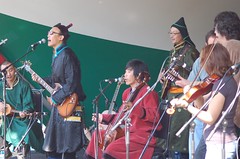
What do you get when you mix roots music with traditional throat singing performed by a bunch of musicians presenting the sounds of the Mongolian population in China? You get Hanggai - a musical treat for the ears.

Dressed in traditional Mongolian garb, the members of Hanggai took to the stage at the Edmonton Folk Music Festival this past weekend for a workshop entitled "Newgrass." Along with The SteelDrivers, Hanggai performed some incredibly energetic music combining electric guitar work with traditional Asian instruments. One piece in particular, which kept getting faster and faster with every verse, had the audience clapping and dancing.

Mixing throat singing with rock sounds is a very unique musical combination. The band is based in Beijing and is starting to get the international recognition it deserves. ~ Paula E. Kirman

Thursday, July 30, 2009

CD Review: Huun Huur Tu and Carmen Rizzo...or Bust!

Huun Huur Tu and Carmen Rizzo
Eternal
Electrofone Music

Huun Huur Tu are throat-singing masters from the Republic of Tuva located in southern Russia. There name can be translated from Tuvan to mean "sunbeams". They have been wowing crowds with their vocal mastery since the early 1990's. The addition of electronic musician, Carmen Rizzo, adds a modern flair to the historical instrumentation of igil (two-stringed instrument), guitar, doshpuluur (lute), flute, byzaanchi (spike fiddle) and drums performed on Eternal. Additional instrumentation is provided on violin, cello, trumpet, cumbus, and bass. "Ancestors Call" is the opening track that begins with an ambulatory drum-beat indicative of galloping horses roaming the taiga. Vocals, although present, are interspersed throughout the album. "Mother Taiga" is an inviting track with all the elements of a great Huun Huur Tu track. Carmen's electronic sounds and ambient backdrops propel the songs into an otherworldly place. Yet, the unfamiliarity is broken by the slightly guttural; but hauntingly beautiful and unmistakable vocals of Huun Huur Tu. Vocals are provided by Kaigal-ool Khovalyg, Sayan Bapa, Radik Tyulyush, and Alexey Saryglar. Eternal is an album that will last for the ages. It's a perfect beginning for those seeking contemporary throat-singing. ~ Matthew Forss

Tuesday, April 21, 2009

CD Review: Mamer - Eagle

Mamer
Eagle
Real World

Born in China's northwestern Xinjiang province, Mamer has been a pervasive figure in Chinagrass music: a blend of traditional Kazakh folk music and Chinese bluegrass. Mamer plays the guitar, dombra, sherter (plucked lute), Jew's harp, and dabel drum. He is joined by members of his band, IZ, on ghijek, kobyz, and sybyzghy (end-blown flute), as well as Mongolia's Hanggai, Grammy Award-winning musician, Bela Fleck on banjo, and a bonus track by the late-Hector Zazou. On Eagle, the ethnic elements of traditional, nomadic cultures encounter contemporary musical production and innovation. The throaty vocals of Mamer float gently alongside folksy instrumentation. In fact, the whole musical package is aptly named Eagle, because, it soars high like an eagle. Everyone who listens to Mamer will find themselves floating with excitement. It's that good. ~ Matthew Forss